
Look up at the sky, glance at the ocean, or pick up a piece of lapis lazuli—the color blue is everywhere. It is a symbol of peace, depth, and vastness. Yet, when you look closely at the living world around you, true, vibrant blue is surprisingly hard to find.
While blue is abundant in the inorganic world, it is an oddity among plants and animals. Most of the dazzling reds, oranges, and yellows we see are produced by chemical pigments—but blue, when it appears, is the result of a spectacular trick of physics.
This is the fascinating premise explored in the video “Why Is Blue So Rare In Nature?,” which dives into the chemistry, biology, and physics that conspire to make this common color an absolute rarity in the tapestry of life.
Credits : It’s Okay To Be Smart, Youtube
. The Chemistry Conundrum: The Pigment Problem
For most colors in the animal and plant kingdoms, the recipe is simple: pigments.
Pigments are chemical compounds (molecules) that absorb certain wavelengths of light and reflect others. For example, chlorophyll absorbs red and blue light, reflecting green. Carotenoids absorb blue-green light, reflecting yellow and orange.
However, animals simply lack an easy, biologically available organic molecule that absorbs red and green light while reflecting the blue spectrum. Many animals derive their colors directly from their diet—think of the pink flamingos that get their hue from the crustaceans and algae they eat. Since the food they eat (mostly plants) is rarely blue, it’s virtually impossible for them to synthesize a blue pigment through this path.
In short, while nature has streamlined the production of pigments for almost every other color, a simple, stable, organic blue pigment remains a chemical stumbling block for most life forms.
2. The Plant Paradox: Why Plants Aren’t Blue
If you were a plant, you would do everything possible to absorb the most energy from the sun. The blue light wavelength is one of the most energetic and critical for photosynthesis.
If a plant were blue, it would mean it was reflecting the highly valuable blue light and absorbing the less-energetic red and green light. By being green (reflecting green light), a plant signals that it is absorbing the most critical parts of the light spectrum (red and blue) for energy production. From an evolutionary and energy-efficiency standpoint, being blue is a terrible strategy for a plant.
3. The “Trick of Light”: Structural Color
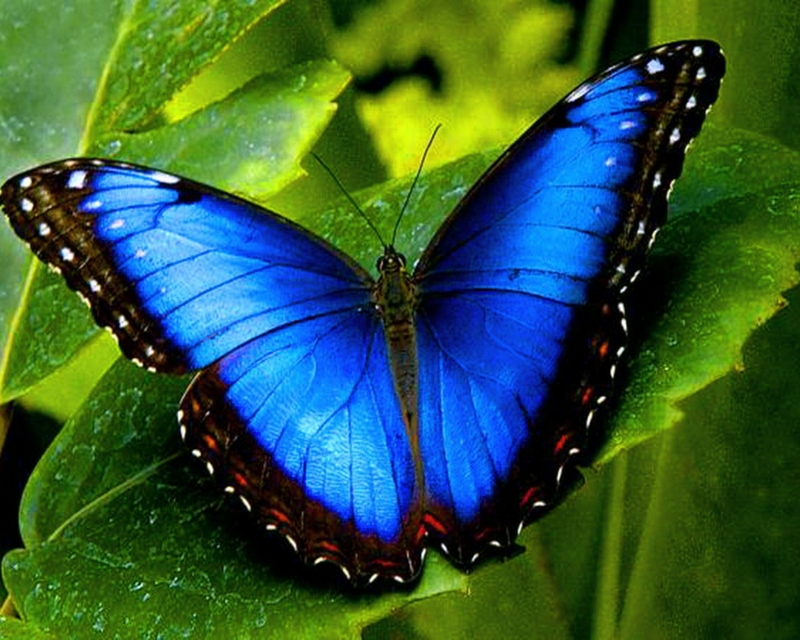
So, when we do see a vivid blue animal—such as the shimmering wings of a Morpho butterfly, the feathers of a bluebird, or the scales of a certain lizard—how is that color produced?
The answer lies not in chemistry, but in physics. These animals use what scientists call structural color, a “trick of the light.”
Instead of using pigments, these organisms have developed intricate, microscopic, repeated structures on their surface (like the tiny scales on a butterfly wing). These structures are spaced precisely to interfere with or scatter light waves.
- When white light hits these nanostructures, all colors except blue are absorbed or pass through.
- The blue wavelength is scattered back at the viewer, making the object appear brilliantly blue.
This is the same physical phenomenon that makes the sky look blue (due to the scattering of light by air molecules) or that creates the iridescent rainbow sheen on a soap bubble or a compact disc. The blue color is an optical illusion—if you crush a blue feather or a Morpho butterfly wing scale, the blue will disappear, leaving behind dull, brown material.
A Beautiful Ingenuity
The rarity of the blue pigment forces nature to resort to a stunning form of physical engineering. While blue is difficult to create chemically, the method by which life generates it—through intricate, microscopic architecture—is arguably far more stunning.
The next time you gaze at a blue jay or a cobalt-colored butterfly, remember that you are not looking at paint, but at a perfectly executed work of optical physics, proof that sometimes, the hardest things to achieve result in the most beautiful feats of natural engineering.